
Accountant — Notion Workspace
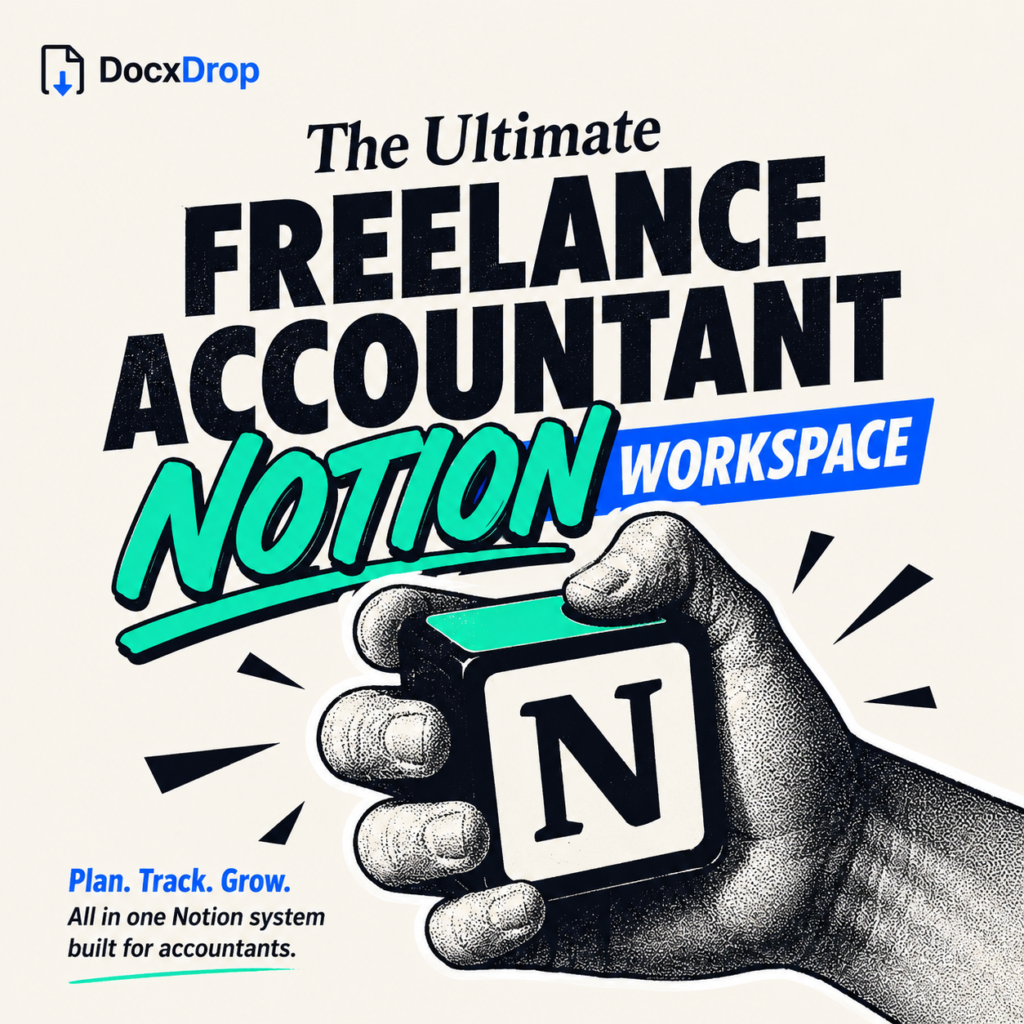
The Freelance Accountant OS is a complete Notion workspace built for independent accountants. Six interconnected databases keep clients, projects, tasks, and compliance deadlines organised in one linked system — so nothing slips and every deadline is visible before it’s due. Up and running in under 30 minutes.
The 5 documents every freelancer needs before their next client call.
5 min read The 5 documents every freelancer needs before their next client call. If you’re still creating these on the fly, you’re leaving money — and credibility — on the table. You’ve just finished a great discovery call. The client is interested. They ask you to send through a proposal and a quote. What happens next tells the whole story. If you open a blank document, copy something you half-remember from last time, fix the formatting for 20 minutes, and send it an hour later with a typo in the pricing table — you’ve already lost ground. Not because the proposal was bad, but because the moment between “interested client” and “signed contract” is the one that decides whether someone trusts you with their money. Here are the five documents that separate freelancers who close consistently from those who improvise every time. The five documents 01 A client proposal template. Scope · Deliverables · Payment terms Not a PDF you redesigned last month. A proper, structured proposal that covers scope, deliverables, timeline, payment terms, and revision policy — in that order, every time. The structure matters as much as the content. Clients read proposals fast. A clear layout signals that you’ve done this before and you know how to deliver. A messy one signals the opposite, regardless of what’s written inside. Your template should have your branding locked in, your standard terms ready to go, and blank fields for the project-specific details. Fill those in. Send it. Done. Branded, locked-in layout = instant professional credibility. 02 A quote or estimate sheet. Pricing · Line items · Scope protection This is where most freelancers leave money on the table — not by charging too little (though that’s common too), but by presenting pricing in a way that creates doubt. Line-item quotes, presented cleanly with clear descriptions and totals, feel more professional than a single number dropped into an email. They also protect you: when scope creep happens — and it will — you have something to point back to. A good quote template has rows for line items, a column for quantities, one for unit rates, and auto-calculated totals. It should take you five minutes to complete, not fifty. Itemised quotes protect you when scope creep arrives — and it always does. 03 A project tracker. Milestones · Status · Client visibility Once the work starts, the client relationship lives and dies on communication. A shared project tracker — even a simple one — tells your client exactly where things stand without them having to ask. It doesn’t need to be sophisticated. Milestone, status, due date, notes. Four columns. Updated weekly. The clients who feel looked after are the ones who refer you and come back. The ones who feel left in the dark are the ones who leave reviews you’d rather not read. Four columns. Updated weekly. That’s what keeps referrals coming. 04 A timesheet or hours log. Time tracking · Invoicing · Pricing clarity If you charge by the hour, or need to account for your time for any reason — tax, invoicing, project review — you need a timesheet. Not a note in your phone. Not a rough estimate. A proper log with date, task, client, and hours. The secondary benefit is just as important: a timesheet shows you where your time actually goes. Most freelancers who start tracking are surprised — and that surprise is usually the beginning of better pricing. Tracking your time is the fastest route to raising your rates. 05 An invoice template. Payment terms · Bank details · Late fees This one seems obvious. But the number of freelancers sending invoices that are missing payment terms, bank details, due dates, or invoice numbers — and then wondering why payment is slow — is genuinely high. A complete invoice includes: your details, the client’s details, invoice number, date issued, due date, itemised services, total, payment method, and late payment terms. Every time. Without exception. The invoice is the last thing the client sees before they pay you. It should look like it came from someone who runs a serious operation. The invoice is the last impression before payment. Make it count. Ready to use — right now You don’t need to build these yourself. Every document above has a ready-made template in the docxdrop library — built for freelancers and consultants, structured for real client workflows. Download once. Use every time. Excel Google Sheets Notion PDF Browse the template library The next client call is coming. Be ready.